Category Archives: Positive Aspects of Life on the Spectrum

Autism and Family Dynamics

Growing up in a family divided into two camps was very difficult for her.

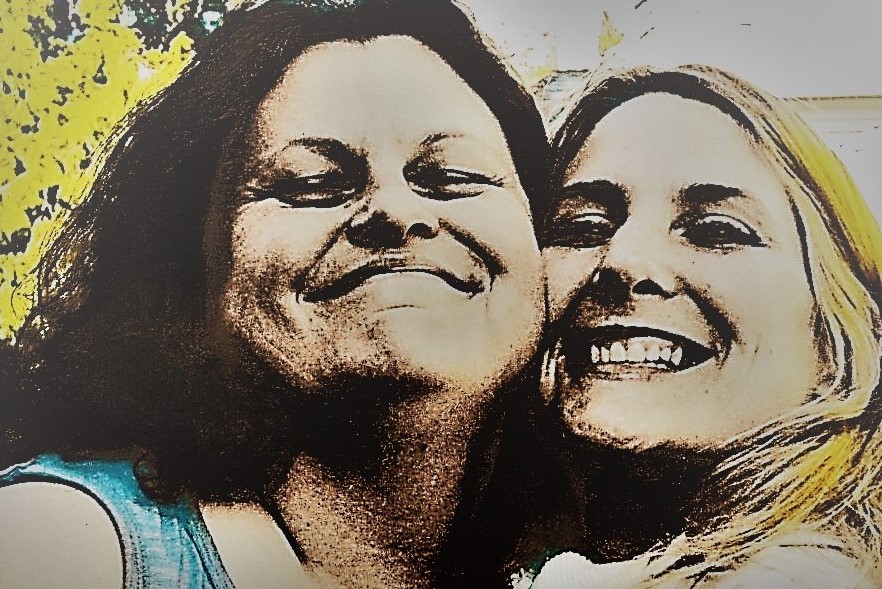
My daughter Suzanne, our dear friend, Mary Anne

I’m a tax preparer. Some would say an apt profession for a person on the autism spectrum.  Working alone, dealing with numbers and calculations, facts and figures.  A skill that requires tremendous concentration and an ability to survey the financial landscape; see the complexities that lie within it.

My daughter, Sue, owns the firm.  She has been keeping books and doing taxes since her late teens. Some of the customers have been loyal to her for more than thirty years.

She is a great boss.  Firm but kind.  She is not autistic.  She has millions of friends (or so it seems) and is very social.

Growing up in a family divided into two camps (autistic and not), was very difficult for her. 

For all of us.  We each have our scars.  My emotional immaturity did not help.  I was very young when I birthed my three children. That’s the reality, not an excuse.

I was very young…

I ‘m wearing the dark shirt. My cousin is with me and my children.

As an aging autist, I look back on my early years, my children’s formative years, and I wince.  However much I loved them, and I did love them unequivocally, I know my child rearing was not any where near ideal.

I didn’t know how to play, how to have fun, how to make sure they had the emotional and physical supports that they needed. 

All I could do was love them in my own way.  Certainly not nearly enough to give them a solid start in life.

And yet, today, all three children have their own homes, are gainfully employed, have friends and family close to them.

I am on good terms with all of my children.  When we talk, it is with respect and love.

I speak with my employer/daughter every day, and the love she has for me comes through clearly, even if those conversations are mostly business.

We all survived.  We are well.  And I am so grateful, because I know I do not deserve this beautiful outcome. 

Tagged , , , ,

Autism and Life Beyond the Herd

This above all: to thine own self be true, And it must follow, as the night the day, Thou canst not then be false to any man*. 

You may often hear or read this quote: the epitome of self-awareness. As someone on the Autism Spectrum, it registers with me. It must be so for many people now and also throughout the ages since Shakespeare’s time, because it is often quoted.

And yet, it is commonly known that humans are born with the herd instinct.

For instance, in Chapter nine of Atomic Habits, James clear states that the human brain is programmed with the desire to be like everybody else. 

This need originates in a protective instinct which triggers the drive to be included–The aptly named ‘herd instinct’. To belong, to imitate the successful integrative and admired behaviours of others, to go along with behaviours we might secretly deplore, stems from our earliest prehistory.

As cave dwellers, and tribesmen, living within the group we were protected, we could benefit from shared resources.  On our own, alone, banished, or ostracized, we became easy targets for wild animals, other tribes, disease and injury. Vulnerable.  Miserable. Usually prey. Ultimately dead.

Safety was an overwhelming issue. As for procreation, the presence of at least one other person was required. Then there’s the bonus of shared resources as well as shared responsibilities. Going along with the prevailing group meant not only survival but a more desirable quality of life.

Theoretically our habits and behaviours are influenced by the culture in which we are born, raised and which we enter into as adults. 

Scientifically we are told that our brains are programmed to want to be aligned with the position assumed by the majority, and the powerful.

Research has proven time and again that being smart, being right, being true to yourself is less important than aligning oneself with the prevailing opinion.  This is ingrained in our being. Man is mentally programmed to respond in this manner.

I realized as I read this that, surprisingly, I had never wanted to be like everyone else.  In my memoir “Unforgiving” I explained that while my teenaged peers wanted to be different, they only really wanted to be different from their parents–not from each other. As for me:

I wanted to be the one and only Margaret Jean on the planet, and I wanted to be indelibly stamped as that single original sample of humanity whose Margaret Jean-ness would permeate every cell of her body and shine through everything she did.

That led me to think about other autistic people, in my family and in my friendships and acquaintances. Many of them have expressed the same feeling: Yes, we want to be accepted.  Yes, we want to be understood.  And no, we do not want to be like everybody else.

We value our uniqueness, the different way we perceive situations and people. Our evaluation of events and information. For instance, what if Temple Grandin had given in to everyone else’s concept of the behaviour of cattle, ignoring her insights as to their behaviours?  What if she had not had the courage to pursue the possibility of uniqueness in her brain?

We shouldn’t feel apologetic for being autistic.  It is how we were born, who we are.

I may misunderstand some social situations, but I may also have a deeper understanding of some.  I may be more intent on social justice than I am on fitting in. Is that really a bad thing? 

Our friends and family want to draw us into the herd for our own protection.  For our own social welfare.  For our own social ease. Admirably, they are thinking of our own good.

But is it what we want? Do we seek permission to be who we intrinsically are?  Do we need it? Those few who make it—how do they do it? By accepting themselves…By being true to who they are.

*Hamlet, act I, scene iii, lines 78–80.

Tagged , , , , , , , , ,

Navigating the Autism Spectrum: Resources for Families and Individuals

An internet search reveals many resources, based on expertise and experience, for both spectrum dwellers and their families. I’ve found a number of researchers, doctors, psychiatrists who focus on autism, as well as parents and siblings of people with autism who have spoken or written about their experiences. And perhaps most of all, I appreciate the people who live their lives publicly riding the spectrum.

Where did my help come from?  Like many others, my help came from my family.  But not my parents. When I was growing up no information was available about children born on the high-functioning end of the spectrum. I was erratically school smart. And socially a constant and predictable embarrassment.

I talked too loud.  I talked too much.  I talked about weird things—like poetry or plays or Shakespeare. I failed Maths and Science but my essay on MacBeth (13 pages) was put in the reference section of the school library. 

My parents found me an embarrassingly unmanageable conundrum. It was my daughter who first understood the role autism played in our lives.

Fortunately, today there are many resources available to families and autists alike.

There are parents who write books sharing their insights, like Ellen Notbohm, author of Ten Things Every Child with Autism Wishes You Knew.

Researchers like Chloe Silverman, author of Understanding Autism, Parents, Doctors, and the History of a Disorder, trace the significant influence of parental advocacy in adjustments to treatment approaches.

And people on the spectrum like Temple Grandin who have boldly lived as they were born to live—unabashedly honest and talented, and faced the world with their truths.

We can read John Elder Robison’s advice in Be Different, or learn about his experiences with transcranial magnetic stimulation in Switched On.  

We can listen to Ted Talks by Temple Grandin about the positive aspects of the autistic brain, or hear Kate Kahle and Ethan Lisi relate that autism is a difference, not a disorder.

We can read shared stories by women about their relationships, parenting, and navigating the workplace in  Spectrum Women, or watch a variety of filmic portrayals of non-neurotypical life on TV.

These shared experiences open the possibility for self-acceptance and personal growth. It’s a feast. An intellectual and experiential banquet. And we are all invited.

Tagged , , , , , , ,

Embracing Neurodiversity on Valentine’s Day

On Valentine’s Day let’s ditch the negatives of being a Spectrum personality. Let’s remind ourselves that more and more, people are realizing the positive aspects of neurodiversity. This can generate a more understanding response when we experience anxiety in social situations. I see a positive shift in public perspective regarding those of us who process information differently.

For instance, more and more TV shows and movies are featuring characters with neurologically diverse traits. Some individuals on the spectrum are being hailed as best selling authors and speakers. This signals an interest in and acceptance of neurological diversity which has not been seen before.

Sometimes scenes on the big screen can help us see ourselves more clearly. Take the intro of Monk for instance. When the detective goes back to straighten the umbrellas hanging on the wall, my partner always says, “That’s me!”

When Monk is facing an uncomfortable social situation, my heart beats faster and my palms sweat. Oddly enough, I don’t feel nearly as anxious when he’s cornered by a bad guy!

That series, Monk, was first aired in 2002 and ran for 8 seasons. For three years, the show held the record for the largest viewing audience after it aired the final episode. This illustrates the incredible popularity of the show.

There are a few TV series now featuring the concept of someone on the spectrum. After Monk came The Big Bang Theory in September of 2007. This series is about two geeky physicists who share an apartment. It’s not only Aspies who enjoy and appreciate the Big Bang. Over twelve seasons, the series consistently ranked in the top ten in their category, placing first in their eleventh season. Over the years, the series won awards for comedy, writing, and acting.

Since then a few series have sprung up, including the Korean Legal series Extraordinary Attorney Woo. It’s well worth turning on the closed captioning for this one. The main character displays autistic characteristics and verbally expresses her needs and idiosyncrasies.

When I’m watching this show, I often find myself thinking, “Yes! That’s exactly how I feel!”

If you’ve never heard of Extraordinary Attorney Woo, you can watch the trailer here: https://www.imdb.com/video/vi3256992281/?playlistId=tt20869502&ref_=vp_rv_ap_0

Here’s another resource. The Autism Research Institute website will direct you to their list of the top 36 movies and TV shows featuring autism.

Want more variety? Me, too. I’m sure there are other shows and books that I’m not aware of. I’d like to hear about your favorite TV show, book or movie that involves autism.

It’s Valentine’s Day: a day to celebrate our unique qualities. A day to enjoy the current, more positive media representations of neurodiversity. A day to give ourselves the gift of loving acceptance.

Tagged , , ,

Sheila’s Story:

Positive Effects of Neuro-divergent Thinking.

In this series of blogs, we are looking at the innovative approach and empathic attitude that Sheila, a Certified Educational Assistant who is on the spectrum, brings to teaching in her classroom.

In the previous blog, she taught her learning-challenged student to do math using a line-drawing on the schoolground.  For the first time in four years of schooling, the student was able to correctly complete a math worksheet on her own, working from the school yard line drawing.  Sheila’s challenge now is to translate that ability into a process that will work in the classroom.  The story continues in her own words.

I copied a number line onto a piece of paper, thinking she could use a marker to count up the lines.

It was a complete disaster. She did not seem to understand any part of it.

“Don’t worry” I told her, “This is not your problem. I’m going to figure out something different and we’ll try again tomorrow.”

The only thing I could think of was that the number line was the traditional horizontal line that most students use. I converted it to a vertical number line, and she was able to use it without a problem.

After a week of using the vertical number line successfully, I brought out the horizontal one and we talked about it. Eventually she was able to transfer what she had learned on the vertical line and successfully apply it to the horizontal line.

Through the repetitive use of the number line, she learned how the numbers in addition and subtraction related to each other. This led to her ability to transfer that information so that she was able to add and subtract using her fingers.

Progress has been slow but steady and she can now add or subtract any two lines of numbers. She can also multiply any number by another one digit number.

 In my work I seek information, materials or support from anyone I deem helpful. Speech therapists are sometimes required. In other situations, kindergarten and grade one teachers who are willing to share resources they have used to help much younger children learn, are invaluable assets.

I sometimes have to invent materials when new approaches are required.  As a result, I’ve become increasingly adept at designing and writing new programs for these students.

Some colleagues wonder why my classrooms are always quiet.  I tell them: “The students work hard to finish their assignments because they know when they finish, I always have a five minute ‘free time’ activity prepared for them.  It’s a fun thing we like to do at the end of the class.

I stay with the students during their fun time and we talk about the game or activity they’re doing, along with their work and how their day went. I always know what my students are thinking about their work, because they talk to me.”

Sheila’s early experiences as a single mom on government assistance with a high-functioning autistic child, combined with her natural ability, compassion and authoritative presence led her to a career as an Educational Assistant. 

But it is Sheila’s neuro-divergent thinking which enables her to explore unusual avenues, facilitating successful outcomes for her challenged students.

“My desire for these students is always first and foremost, Success!” Sheila says, “I want them to experience success, and I’m going to bring everything to the table, everything I’ve got to help make that happen.”

Tagged , , , , , , ,

Positive Aspects: Sheila’s Story continued.

In the previous two blogs, I’ve entertained positive aspects of non-neuro typical thinking, and presented the back story of Sheila, a single mom who found that both she and her young son were on the autism spectrum. This begins the story of the mindset Sheila brings to her work as a teacher’s aide, and the empathic understanding through which she views her students. The following is part three of Sheila’s story, told in her own words.

Once the school finally had the information they needed to support my son, I decided to join the workforce again.  But I needed to find a profession. Teaching was a direction I’d been encouraged to pursue since elementary school and was one which held a very strong appeal. Since the reality was that I had limited financial resources and a special needs son who demanded time and attention, a Certified Educational Assistant (CEA) seemed like a good fit for me and a more reasonable option.  Grants paid for the college and university classes I needed, and I was able to complete the course at a pace that worked for my son.

When I am assigned a student, I am aware that often many aides and teachers have already tried a wide variety of learning tools and resources to support the student’s ability to understand and integrate information or concepts. In other words, to “learn”.

With the groundwork that has already been done there is a lot of information about which approaches have not succeeded, as well as a list of interests, strengths and even passions that the student is able to contribute to the process.

Having studied the file, I turn to the child. I look for patterns of behaviour and sparks of interest and consider how these can be intercepted and guided toward opening new channels of insight and communication.

In one instance, a grade four student was unable to correctly add single digit numbers up to twenty without support. This was something I had never encountered before. After a brief assessment with the student, I saw that she could count past 100 and easily recognize numbers. She knew 1+1=2 and 1+2=3 but did not know what 1+3 equaled.

I thought about this student’s classroom experience, what it would be like to watch your peers work independently and with only a little help, get the right answers. And all you can do is sit there, frustrated and anxious, staring at the numbers, struggling to grasp the process, all the time thinking “I just don’t get it!”

The school was giving me the resources and the opportunity to assist this child, and I was determined to help her. To find the key that would unlock the door to some level of success.

Sheila’s innovative approach and her student’s learning process follow in the next Blog.

Tagged ,

Positive Aspects of Life on the Spectrum: Sheila’s Story.

In this blog series, I am presenting lives that express the ways in which not being Neuro Typical is a career asset.  Thinking outside the box is normal for people on the autism spectrum. In certain circumstances this attribute of our condition can be beneficial. 

To continue Sheila’s story, begun in the previous blog, I will first relate some background information, along with some early practices she implemented. These temporary solutions to her son, Seamus’ social and learning problems ultimately led to her ability to explore unique and innovative methodology, which will be discussed in the next blog in this series. 

Sheila’s school experience was successful both academically and socially. However, later circumstances rendered her a single mom on welfare with an autistic child, Seamus.

As a result, Sheila experienced the understanding of how frustrating life can be for both parent and child, when someone is trying their best, socially and academically, and yet, is largely unsuccessful at one or both.

Seamus was a loving boy, but he found socializing at school impossible. Ostracized and bullied, he could never join in any games, and he had no friends to ‘hang’ with at lunch or recess. Sheila decided to see how she could help.

Every lunch hour she joined Seamus on the playground. Standing with him, she would ask, “Who wants to play baseball?” Invariably several children would crowd around.  “Alright,” she’d say, “There’s only one rule, and that is, Seamus gets to play.”

The ‘Seamus ball game’ soon became a popular lunch time activity! Sheila would also stay later on occasion to help in the classroom if Seamus was having a problem with the work. Her organized approach, ability to quickly assess a situation through Seamus’ eyes and her friendly but authoritative air made her an asset in the classroom.

In the late 1990’s, not a lot was known about the autism spectrum, especially the high end kids who seemed to have no trouble learning but couldn’t manage their social life. After countless incomplete diagnoses, from leaky gut to ADD and ADHD, Sheila felt at a loss. She didn’t like the effect of the medications prescribed for her son, and he didn’t either, often refusing to take them.

One day, after attending a conference on autism, a teacher from Seamus’ school phoned Sheila.   I think I know what Seamus has, she told Sheila. When given a list of the symptomatic behaviours, Sheila recognized to her surprise, that it was not only Seamus who was on the spectrum–she was on the spectrum, too! This self-knowledge opened up a wide range of concerns and possibilities for both Sheila and her son.

In her book, Aspergirls, Rudy Simone states that for adults, being diagnosed can be a relief. A diagnosis for a child can also bring relief for parents like Sheila, who until Seamus’ diagnosis did not know where to turn for helpful information. In the years before Sheila was diagnosed, her focus was on helping Seamus.

Little was known about how to help those on the high end of the spectrum, then known as Asperger’s. With the help of his school staff, his family doctor, and Sheila’s campaigning, Seamus was able to access a facility for testing.  Once he was diagnosed, funding became available for special programs and activities for him. 

Every dime had to be accounted for, and it could only be spent on the special needs or activities for him, Sheila recalls.

Sheila’s experience with her son provided her insight into similar situations. She understands the frustration of having a child who neither learns nor interacts in the same way as their peers. She has gained the power of finding those keys which open doors for students who feel stymied by the different ways their brain works.

Success is what these kids need to experience. Sheila tells me, referring to both behavioural and learning issues. Helping her students find the self-confidence that will allow for success, is the motivating factor in her work.

Tagged , , , , , , , ,