Tag Archives: autistic

Autism and Family Dynamics

Growing up in a family divided into two camps was very difficult for her.

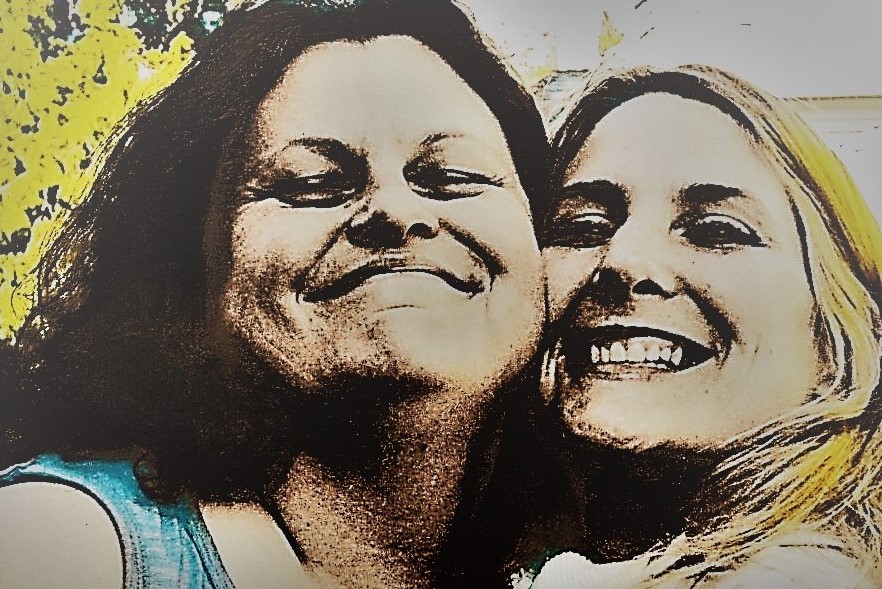
My daughter Suzanne, our dear friend, Mary Anne

I’m a tax preparer. Some would say an apt profession for a person on the autism spectrum.  Working alone, dealing with numbers and calculations, facts and figures.  A skill that requires tremendous concentration and an ability to survey the financial landscape; see the complexities that lie within it.

My daughter, Sue, owns the firm.  She has been keeping books and doing taxes since her late teens. Some of the customers have been loyal to her for more than thirty years.

She is a great boss.  Firm but kind.  She is not autistic.  She has millions of friends (or so it seems) and is very social.

Growing up in a family divided into two camps (autistic and not), was very difficult for her. 

For all of us.  We each have our scars.  My emotional immaturity did not help.  I was very young when I birthed my three children. That’s the reality, not an excuse.

I was very young…

I ‘m wearing the dark shirt. My cousin is with me and my children.

As an aging autist, I look back on my early years, my children’s formative years, and I wince.  However much I loved them, and I did love them unequivocally, I know my child rearing was not any where near ideal.

I didn’t know how to play, how to have fun, how to make sure they had the emotional and physical supports that they needed. 

All I could do was love them in my own way.  Certainly not nearly enough to give them a solid start in life.

And yet, today, all three children have their own homes, are gainfully employed, have friends and family close to them.

I am on good terms with all of my children.  When we talk, it is with respect and love.

I speak with my employer/daughter every day, and the love she has for me comes through clearly, even if those conversations are mostly business.

We all survived.  We are well.  And I am so grateful, because I know I do not deserve this beautiful outcome. 

Tagged , , , ,

Navigating Relationships: Insights from Autism and Philosophy

Growing up on the autism spectrum, I never understood power in personal relationships.  I naively assumed that as adults, people would just naturally treat each other with respect and acceptance. 

People would want what was best for themselves and for the other person.

And in the workplace that would translate to balancing out the needs of the client, with the efficiency and profitability of the firm, while developing processes which would enable workers to do the best possible job with efficiency, pride and productivity.  For a fair wage.

Once I found myself in the ‘real’ world, I had no idea how to navigate the stresses and anxieties of very different personalities malfunctioning together in the work place.

I once complained to my sister that in the personal relationship I was then immersed in, I was the only powerless person.  I was sobbing.  Her response was straightforward:  You have the power, Marg.  You just don’t use it.

The truth? I didn’t know how.

I’ve learned to hold my own since then.  And recently I’ve found two books that clearly speak to this issue. It’s a relief to find authors who clarify the critical aspects of successfully managing stressful interpersonal relationships. 

Because we all find ourselves in situations that require working with or being with other people. 

Situations like Life.

Ichiro Kishimi and Fumitake Koga, two Japanese authors, explore the emotional fallout that can result from coming into contact with ‘the real world’. In their book, The Courage to be Disliked they discuss the calming effects of accepting and embracing who you are.

This book does not even mention autism spectrum disorder. 

Instead, the authors talk about our response to people and situations, and how we can find contentment regardless of what others may think about who we are and what we choose to do.

The format Koga and Kishimi chose for the book is loosely based on Plato’s dialogues.  That is, it’s a plain-language conversation between a philosopher and a young man, revealing the philosophical or Adlerian keys to being true to yourself.

I enjoyed the back and forth discussion; the young man constantly challenging the concepts and ideas put forth by the philosopher.

The discussions  explore the acknowledgement that others are not always going to be aligned with your personality and goals.  In short, they examine how a person can best move forward regardless of the opinions and/or criticisms of others.

Kishimi and Koga discuss our concern about what others might think—and note that this is different from caring about others—and how that emotional involvement with what others think about us, can hinder progress toward being our best self.

It’s a clear philosophical foundation for living your life freed from the inhibiting power of what other people think.

Along the same lines, but much more in the vein of a self-help revelation is The Let Them Theory by Mel Robbins. 

Robbins covers topics from achieving your goals to making, maintaining and letting go of friendships.  Her premise is simple: Do people shun you?  Let them. Do others criticize you?  Let them.  Do they do things you would never do?  Let them.  Let go of critical judgements, critical of yourself and of others.

The letting go is only the first step.  Robbins is clear that two steps are needed for this theory to work in an emotionally healthy way. The second step is, after acknowledging the issue that makes you think, “Let them”, you will then go on to explore self-validation in a way that is satisfying to you.

Her delivery, far from being philosophical, is very personal and direct. 

As spectrum riders, we can mourn our social/political/employment situation, or lack thereof, to our heart’s content. But at some point, we have to pick up our tents and move into the real world.  And hopefully?  Make a difference, however small.

Yours truly,

Margaret Jean.

Tagged , , , , , , ,

Navigating the Autism Spectrum: Resources for Families and Individuals

An internet search reveals many resources, based on expertise and experience, for both spectrum dwellers and their families. I’ve found a number of researchers, doctors, psychiatrists who focus on autism, as well as parents and siblings of people with autism who have spoken or written about their experiences. And perhaps most of all, I appreciate the people who live their lives publicly riding the spectrum.

Where did my help come from?  Like many others, my help came from my family.  But not my parents. When I was growing up no information was available about children born on the high-functioning end of the spectrum. I was erratically school smart. And socially a constant and predictable embarrassment.

I talked too loud.  I talked too much.  I talked about weird things—like poetry or plays or Shakespeare. I failed Maths and Science but my essay on MacBeth (13 pages) was put in the reference section of the school library. 

My parents found me an embarrassingly unmanageable conundrum. It was my daughter who first understood the role autism played in our lives.

Fortunately, today there are many resources available to families and autists alike.

There are parents who write books sharing their insights, like Ellen Notbohm, author of Ten Things Every Child with Autism Wishes You Knew.

Researchers like Chloe Silverman, author of Understanding Autism, Parents, Doctors, and the History of a Disorder, trace the significant influence of parental advocacy in adjustments to treatment approaches.

And people on the spectrum like Temple Grandin who have boldly lived as they were born to live—unabashedly honest and talented, and faced the world with their truths.

We can read John Elder Robison’s advice in Be Different, or learn about his experiences with transcranial magnetic stimulation in Switched On.  

We can listen to Ted Talks by Temple Grandin about the positive aspects of the autistic brain, or hear Kate Kahle and Ethan Lisi relate that autism is a difference, not a disorder.

We can read shared stories by women about their relationships, parenting, and navigating the workplace in  Spectrum Women, or watch a variety of filmic portrayals of non-neurotypical life on TV.

These shared experiences open the possibility for self-acceptance and personal growth. It’s a feast. An intellectual and experiential banquet. And we are all invited.

Tagged , , , , , , ,