Tag Archives: mental-health

Autism and Family Dynamics

Growing up in a family divided into two camps was very difficult for her.

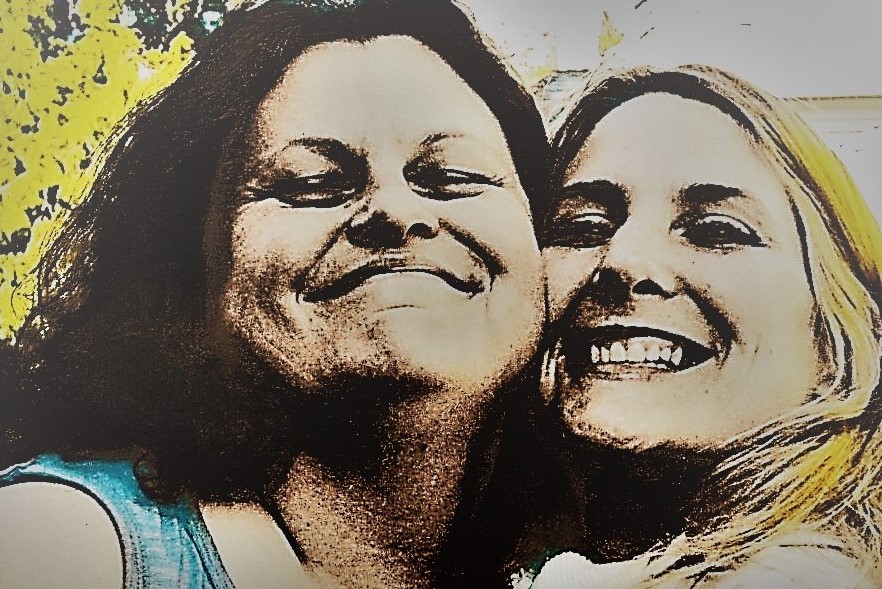
My daughter Suzanne, our dear friend, Mary Anne

I’m a tax preparer. Some would say an apt profession for a person on the autism spectrum.  Working alone, dealing with numbers and calculations, facts and figures.  A skill that requires tremendous concentration and an ability to survey the financial landscape; see the complexities that lie within it.

My daughter, Sue, owns the firm.  She has been keeping books and doing taxes since her late teens. Some of the customers have been loyal to her for more than thirty years.

She is a great boss.  Firm but kind.  She is not autistic.  She has millions of friends (or so it seems) and is very social.

Growing up in a family divided into two camps (autistic and not), was very difficult for her. 

For all of us.  We each have our scars.  My emotional immaturity did not help.  I was very young when I birthed my three children. That’s the reality, not an excuse.

I was very young…

I ‘m wearing the dark shirt. My cousin is with me and my children.

As an aging autist, I look back on my early years, my children’s formative years, and I wince.  However much I loved them, and I did love them unequivocally, I know my child rearing was not any where near ideal.

I didn’t know how to play, how to have fun, how to make sure they had the emotional and physical supports that they needed. 

All I could do was love them in my own way.  Certainly not nearly enough to give them a solid start in life.

And yet, today, all three children have their own homes, are gainfully employed, have friends and family close to them.

I am on good terms with all of my children.  When we talk, it is with respect and love.

I speak with my employer/daughter every day, and the love she has for me comes through clearly, even if those conversations are mostly business.

We all survived.  We are well.  And I am so grateful, because I know I do not deserve this beautiful outcome. 

Tagged , , , ,

Navigating Relationships: Insights from Autism and Philosophy

Growing up on the autism spectrum, I never understood power in personal relationships.  I naively assumed that as adults, people would just naturally treat each other with respect and acceptance. 

People would want what was best for themselves and for the other person.

And in the workplace that would translate to balancing out the needs of the client, with the efficiency and profitability of the firm, while developing processes which would enable workers to do the best possible job with efficiency, pride and productivity.  For a fair wage.

Once I found myself in the ‘real’ world, I had no idea how to navigate the stresses and anxieties of very different personalities malfunctioning together in the work place.

I once complained to my sister that in the personal relationship I was then immersed in, I was the only powerless person.  I was sobbing.  Her response was straightforward:  You have the power, Marg.  You just don’t use it.

The truth? I didn’t know how.

I’ve learned to hold my own since then.  And recently I’ve found two books that clearly speak to this issue. It’s a relief to find authors who clarify the critical aspects of successfully managing stressful interpersonal relationships. 

Because we all find ourselves in situations that require working with or being with other people. 

Situations like Life.

Ichiro Kishimi and Fumitake Koga, two Japanese authors, explore the emotional fallout that can result from coming into contact with ‘the real world’. In their book, The Courage to be Disliked they discuss the calming effects of accepting and embracing who you are.

This book does not even mention autism spectrum disorder. 

Instead, the authors talk about our response to people and situations, and how we can find contentment regardless of what others may think about who we are and what we choose to do.

The format Koga and Kishimi chose for the book is loosely based on Plato’s dialogues.  That is, it’s a plain-language conversation between a philosopher and a young man, revealing the philosophical or Adlerian keys to being true to yourself.

I enjoyed the back and forth discussion; the young man constantly challenging the concepts and ideas put forth by the philosopher.

The discussions  explore the acknowledgement that others are not always going to be aligned with your personality and goals.  In short, they examine how a person can best move forward regardless of the opinions and/or criticisms of others.

Kishimi and Koga discuss our concern about what others might think—and note that this is different from caring about others—and how that emotional involvement with what others think about us, can hinder progress toward being our best self.

It’s a clear philosophical foundation for living your life freed from the inhibiting power of what other people think.

Along the same lines, but much more in the vein of a self-help revelation is The Let Them Theory by Mel Robbins. 

Robbins covers topics from achieving your goals to making, maintaining and letting go of friendships.  Her premise is simple: Do people shun you?  Let them. Do others criticize you?  Let them.  Do they do things you would never do?  Let them.  Let go of critical judgements, critical of yourself and of others.

The letting go is only the first step.  Robbins is clear that two steps are needed for this theory to work in an emotionally healthy way. The second step is, after acknowledging the issue that makes you think, “Let them”, you will then go on to explore self-validation in a way that is satisfying to you.

Her delivery, far from being philosophical, is very personal and direct. 

As spectrum riders, we can mourn our social/political/employment situation, or lack thereof, to our heart’s content. But at some point, we have to pick up our tents and move into the real world.  And hopefully?  Make a difference, however small.

Yours truly,

Margaret Jean.

Tagged , , , , , , ,

Navigating the Autism Spectrum: Resources for Families and Individuals

An internet search reveals many resources, based on expertise and experience, for both spectrum dwellers and their families. I’ve found a number of researchers, doctors, psychiatrists who focus on autism, as well as parents and siblings of people with autism who have spoken or written about their experiences. And perhaps most of all, I appreciate the people who live their lives publicly riding the spectrum.

Where did my help come from?  Like many others, my help came from my family.  But not my parents. When I was growing up no information was available about children born on the high-functioning end of the spectrum. I was erratically school smart. And socially a constant and predictable embarrassment.

I talked too loud.  I talked too much.  I talked about weird things—like poetry or plays or Shakespeare. I failed Maths and Science but my essay on MacBeth (13 pages) was put in the reference section of the school library. 

My parents found me an embarrassingly unmanageable conundrum. It was my daughter who first understood the role autism played in our lives.

Fortunately, today there are many resources available to families and autists alike.

There are parents who write books sharing their insights, like Ellen Notbohm, author of Ten Things Every Child with Autism Wishes You Knew.

Researchers like Chloe Silverman, author of Understanding Autism, Parents, Doctors, and the History of a Disorder, trace the significant influence of parental advocacy in adjustments to treatment approaches.

And people on the spectrum like Temple Grandin who have boldly lived as they were born to live—unabashedly honest and talented, and faced the world with their truths.

We can read John Elder Robison’s advice in Be Different, or learn about his experiences with transcranial magnetic stimulation in Switched On.  

We can listen to Ted Talks by Temple Grandin about the positive aspects of the autistic brain, or hear Kate Kahle and Ethan Lisi relate that autism is a difference, not a disorder.

We can read shared stories by women about their relationships, parenting, and navigating the workplace in  Spectrum Women, or watch a variety of filmic portrayals of non-neurotypical life on TV.

These shared experiences open the possibility for self-acceptance and personal growth. It’s a feast. An intellectual and experiential banquet. And we are all invited.

Tagged , , , , , , ,

United We Stand, Divided We….

Exploring the Mind/Body Connection Part 2

I am grateful to my body for all the years it has amazingly, carried me through this life. In elementary school, it helped me win races and high jump and in high school, allowed me to participate in team sports like baseball and basketball. I could act in film and on stage. I could walk for miles and often had to.  This body bore me three fine children.  And in the confines of this body, I cared for a husband with a critical heart condition. 

But ultimately, I never thought much about the physical embodiment that accompanied ‘me’ wherever I went. I stumbled, tripped, rushed, and blundered.

Alternately, I would sit for hours in an unhealthy position, lost in a book or a problem or a project.  My body was just there with me, taken for granted, unnoticed, like an unloved child in the room.

The most positive remark I can make about my attitude toward my body is that I have always been aware that mobility is crucial to a vibrant and happy life. So, this project of honouring my physical self should be a simple matter, right?

The trouble is my mind seems to be jealous.

Just when I think I’m doing well with regular breaks from the computer for movement and stretching, or going to the gym, my mind steps in and takes over, completely absorbing me for hours beyond the time I have allotted it, and once again robbing my body of its due.

Why do I live so much in my head?  Why are my thoughts a constant flow of unremitting playback and commentary? 

Why can I not enjoy a mental silence now and then?  A cessation of mental chatter, a period of serenity which would allow me to breathe more deeply, to drink in the moment, the bright purple and yellow of the primulas outside my window, the hummingbirds hovering at the feeder, the snow on the roofs across the way.

Suddenly, it becomes clear: to give my body its due, I must be able to exert some control over my mind.

My friend, Richard, an expert in mindfulness tells me it will take a conscious effort to co-ordinate my body and mind. It’s a matter of giving my physicality the mindful recognition it deserves. And treating it respectfully. 

Richard says I must learn to be still: to extricate myself from this mental rat race in which I seem perpetually absorbed.

I must deliberately engage both body and mind, he tells me, not only when motion is involved but also when it’s time to be still!

He says there is a way to harmoniously reunite my mind with my body. That I must recognize that there are no grounds for perceiving these aspects of myself as a duality. But this body/mind division seems so real to me. If he’s right, I’m not dealing with two separate entities, body and mind are intimately connected. It seems they just don’t recognize each other now.

I must introduce my body and my mind to each other.

I’m going to ask Richard to tell me more about this. What does recognizing the oneness of my body and mind look like in everyday life?  How do I practice this kind of unity? Does anyone else feel this disconnect–this separation of these two aspects of self? How do we reconnect, assuming the connection existed in the first place?

Come join me in my exploration of the mind/body connection!

Tagged , , , , , ,

Positive Aspects of Life on the Spectrum: Sheila’s Story.

In this blog series, I am presenting lives that express the ways in which not being Neuro Typical is a career asset.  Thinking outside the box is normal for people on the autism spectrum. In certain circumstances this attribute of our condition can be beneficial. 

To continue Sheila’s story, begun in the previous blog, I will first relate some background information, along with some early practices she implemented. These temporary solutions to her son, Seamus’ social and learning problems ultimately led to her ability to explore unique and innovative methodology, which will be discussed in the next blog in this series. 

Sheila’s school experience was successful both academically and socially. However, later circumstances rendered her a single mom on welfare with an autistic child, Seamus.

As a result, Sheila experienced the understanding of how frustrating life can be for both parent and child, when someone is trying their best, socially and academically, and yet, is largely unsuccessful at one or both.

Seamus was a loving boy, but he found socializing at school impossible. Ostracized and bullied, he could never join in any games, and he had no friends to ‘hang’ with at lunch or recess. Sheila decided to see how she could help.

Every lunch hour she joined Seamus on the playground. Standing with him, she would ask, “Who wants to play baseball?” Invariably several children would crowd around.  “Alright,” she’d say, “There’s only one rule, and that is, Seamus gets to play.”

The ‘Seamus ball game’ soon became a popular lunch time activity! Sheila would also stay later on occasion to help in the classroom if Seamus was having a problem with the work. Her organized approach, ability to quickly assess a situation through Seamus’ eyes and her friendly but authoritative air made her an asset in the classroom.

In the late 1990’s, not a lot was known about the autism spectrum, especially the high end kids who seemed to have no trouble learning but couldn’t manage their social life. After countless incomplete diagnoses, from leaky gut to ADD and ADHD, Sheila felt at a loss. She didn’t like the effect of the medications prescribed for her son, and he didn’t either, often refusing to take them.

One day, after attending a conference on autism, a teacher from Seamus’ school phoned Sheila.   I think I know what Seamus has, she told Sheila. When given a list of the symptomatic behaviours, Sheila recognized to her surprise, that it was not only Seamus who was on the spectrum–she was on the spectrum, too! This self-knowledge opened up a wide range of concerns and possibilities for both Sheila and her son.

In her book, Aspergirls, Rudy Simone states that for adults, being diagnosed can be a relief. A diagnosis for a child can also bring relief for parents like Sheila, who until Seamus’ diagnosis did not know where to turn for helpful information. In the years before Sheila was diagnosed, her focus was on helping Seamus.

Little was known about how to help those on the high end of the spectrum, then known as Asperger’s. With the help of his school staff, his family doctor, and Sheila’s campaigning, Seamus was able to access a facility for testing.  Once he was diagnosed, funding became available for special programs and activities for him. 

Every dime had to be accounted for, and it could only be spent on the special needs or activities for him, Sheila recalls.

Sheila’s experience with her son provided her insight into similar situations. She understands the frustration of having a child who neither learns nor interacts in the same way as their peers. She has gained the power of finding those keys which open doors for students who feel stymied by the different ways their brain works.

Success is what these kids need to experience. Sheila tells me, referring to both behavioural and learning issues. Helping her students find the self-confidence that will allow for success, is the motivating factor in her work.

Tagged , , , , , , , ,

A Positive Aspect of Life on the Spectrum.

I’d like to further explore that position in this blog.  

Being on the spectrum has the advantage of enabling us to see events from a focused, objective perspective, one which is devoid of much of the emotional, social ‘baggage’ which often burden neural typicals.

From this distinctive, intellectually isolated position, we are able to recognize the ‘essence’ of scientific and political dilemmas which, when no longer ‘wrapped up’ in irrelevant social diplomacy, are much simpler to resolve.

We see significant examples of this in Elon Musk, Greta Thunberg, and Temple Grandin, people whose unique perspectives have promoted both awareness of and possible solutions to critical environmental and industrial challenges currently impacting all of humanity.

If you are on the spectrum, you may wish to consider whether your ‘lack of alignment’ with decisions being made for all of us by neural typical politicians and industrialists is because you are somehow ‘deficient’, or rather because you are better positioned to recognise, isolate and promote workable solutions to complex issues.

There is a difference in the way the human brain processes incoming information in neural typicals vs those on the spectrum. Our uniqueness allows us a different outlook on problems and often, a unique approach to them.  Our lack of emotional or social involvement encourages us to see issues objectively, and therefore to approach solutions rationally. 

 You may wish to discuss this with acquaintances who are also on the spectrum. You may be surprised at how others share both this viewpoint, and the frustration which arises from being marginalized.

 Once you are receptive to the notion of a positive influence resulting from the differing neurological processes, you will find no shortage of examples of the benefits of this unique perspective,

Sheila is one such person who brings a unique talent to her work.

Sheila is an Educational Assistant who, in her 20 year career, has worked with educationally challenged children ranging from kindergarten through high school. 

Early on, her talent for this work was discovered to be exceptional, and subsequently she often finds herself assigned the students with the most serious limitations, ranging from behavioural issues to those with significant brain differences..

In my next blog posting I will explore some specific, unique approaches that Sheila uses with great success.

You will see how, when her autistic mind identifies and isolates problems, successful solutions inevitably follow. You may find that they resonate with you. You may even find them quite fascinating!

Tagged , , , , , ,

Aspergirls by Rudy Simone

An Empowering Read for Women on the Autism Spectrum

I appreciate Rudy Simone’s acknowledgement that sometimes our social behaviours result in “botched interactions” causing feelings of guilt and self-blame. We on the spectrum have all had those experiences!

I learned that I was on the spectrum when my grandson was diagnosed. My daughter phoned me, very excited, and added, “And Mom, you and I also have all the symptoms!”

It was a joyful and terrifying moment. Joyful because suddenly there was an explanation for my horrific record of social blunders. Terrifying because it meant that I had been stumbling blindly through school, marriages and child-rearing without the benefit of this knowledge.

The awareness gave me the gift of compassion for myself. As Simone says in Aspergirls, diagnosis comes with a sensation of relief. 

I would like to say that I stopped feeling inadequate in that moment, but like the women in Simone’s book, and as anyone on the spectrum knows, that fear of being found lacking in social situations does not suddenly vanish.

Still, I’ve found that sense of insecurity can sometimes be useful. Feeling uncertain can make me hesitant at times, a caution which allows me to reassess a situation and perhaps even quickly think through and revise my initial instinctive response.

Simone notes that not being diagnosed invites all kinds of speculation, including unflattering and insulting conclusions about what our ‘problem’ is. 

People will often assume that our lack of social propriety is intentional. Or, seeing that we are vulnerable, some folks can’t resist the cruel opportunity to take advantage of our inability to appropriately defend ourselves in social situations, perhaps even to elevate their own social status in the eyes of their peers.

I found Simone’s book reassuring, in that she not only writes about her own experience, but also presents the comments and experiences of other ‘Aspergirls’. 

She covers a wide range of topics, from dating, sex and relationships, including ending those relationships (burning bridges), along with bullying at school, managing employment situations, stimming behaviours and sensory overload. Each chapter contains personal anecdotes, research and information, and ends with advice to Aspergirls and their parents.

Aspergirls is not only informative, it is a book that will make any girl on the autism spectrum feel at home in its pages, which will help parents, siblings and significant others to perhaps see the world from our point of view.

Tagged , , , , , , ,