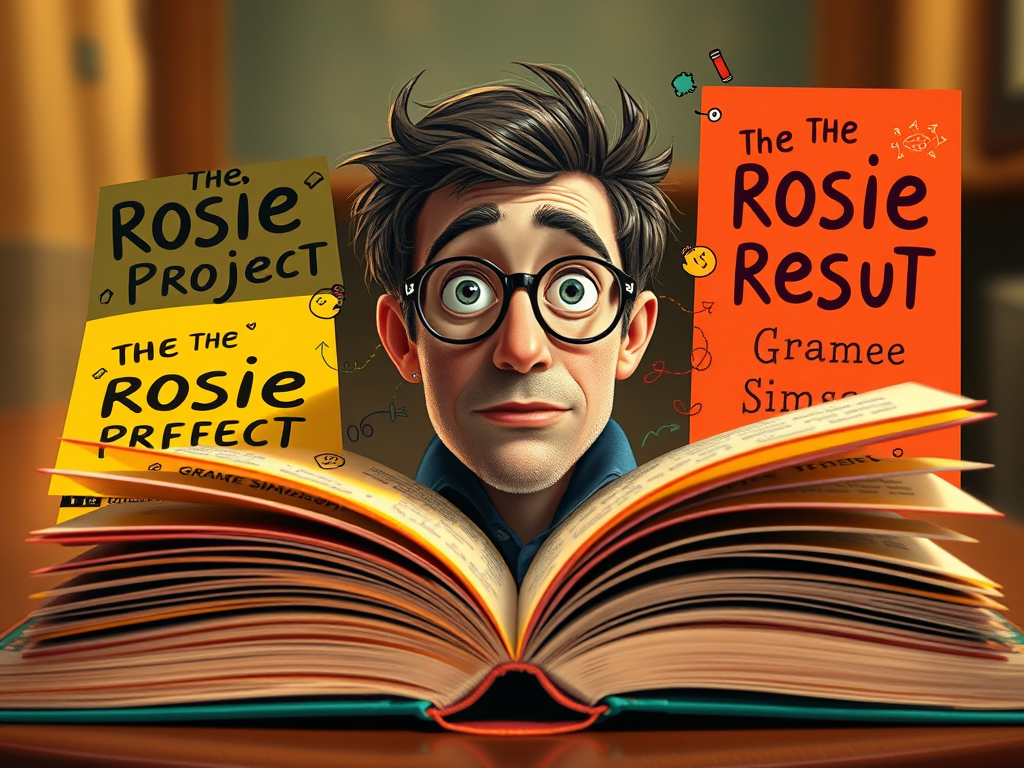
The Rosie Series: A Great Read for Spectrum Riders & Their Significant Others.

Has AI deliberately misspelled titles and author name?
Has AI misspelled titles and author name to avoid copyright issues?

The Rosie Books: The Rosie Project: 2013, The Rosie Effect: 2014, The Rosie Result: 2019

Graeme Simsion does not claim his series of funny, sensitive books featuring his character, Don Tillman, is about someone with Asperger’s or anyone who finds themselves on the spectrum.  But it is.  My partner read it, and he said that Graeme Simsion writes like I think.  I state my case.

One of the reviewers is quoted as saying “Sometimes you just need a smart love story that will make anyone, man or woman, laugh out loud.”  Reading that you might think that Simsion is making fun of us non-neurotypicals.  But he is honestly not. 

I laughed a lot when I read this book, and I know some of that came from the situations the author put our protagonist (Don) in, and Don’s response to them, but another aspect that made me laugh out loud was the joy of recognition. 

It’s comforting to know that Simsion could take our predicament and in the bright light of day, show the world with humour and tenderness what it’s like to be us.

Throughout these books, I recognized aspects of my grandsons, my daughter and myself. We share some characteristics, but each have put our own personal stamp on the spectrum label, as has every other Aspie.

My partner, who is not on the spectrum, on reading the Rosie Effect, had great admiration for Don (the main character).  “Here is this guy with severe social deficits, doing everything he can to correct them,” he told me when he finished reading the book.  “The guy knows he’s limited and he works in every conceivable way to change that.”

If only to acquaint ourselves with that attitude, and to enjoy a humorous look at what it is to be ‘us’ in social situations, this book truly is a must read.

Tagged , , , , , ,

Navigating the Autism Spectrum: Resources for Families and Individuals

An internet search reveals many resources, based on expertise and experience, for both spectrum dwellers and their families. I’ve found a number of researchers, doctors, psychiatrists who focus on autism, as well as parents and siblings of people with autism who have spoken or written about their experiences. And perhaps most of all, I appreciate the people who live their lives publicly riding the spectrum.

Where did my help come from?  Like many others, my help came from my family.  But not my parents. When I was growing up no information was available about children born on the high-functioning end of the spectrum. I was erratically school smart. And socially a constant and predictable embarrassment.

I talked too loud.  I talked too much.  I talked about weird things—like poetry or plays or Shakespeare. I failed Maths and Science but my essay on MacBeth (13 pages) was put in the reference section of the school library. 

My parents found me an embarrassingly unmanageable conundrum. It was my daughter who first understood the role autism played in our lives.

Fortunately, today there are many resources available to families and autists alike.

There are parents who write books sharing their insights, like Ellen Notbohm, author of Ten Things Every Child with Autism Wishes You Knew.

Researchers like Chloe Silverman, author of Understanding Autism, Parents, Doctors, and the History of a Disorder, trace the significant influence of parental advocacy in adjustments to treatment approaches.

And people on the spectrum like Temple Grandin who have boldly lived as they were born to live—unabashedly honest and talented, and faced the world with their truths.

We can read John Elder Robison’s advice in Be Different, or learn about his experiences with transcranial magnetic stimulation in Switched On.  

We can listen to Ted Talks by Temple Grandin about the positive aspects of the autistic brain, or hear Kate Kahle and Ethan Lisi relate that autism is a difference, not a disorder.

We can read shared stories by women about their relationships, parenting, and navigating the workplace in  Spectrum Women, or watch a variety of filmic portrayals of non-neurotypical life on TV.

These shared experiences open the possibility for self-acceptance and personal growth. It’s a feast. An intellectual and experiential banquet. And we are all invited.

Tagged , , , , , , ,

Embracing Neurodiversity on Valentine’s Day

On Valentine’s Day let’s ditch the negatives of being a Spectrum personality. Let’s remind ourselves that more and more, people are realizing the positive aspects of neurodiversity. This can generate a more understanding response when we experience anxiety in social situations. I see a positive shift in public perspective regarding those of us who process information differently.

For instance, more and more TV shows and movies are featuring characters with neurologically diverse traits. Some individuals on the spectrum are being hailed as best selling authors and speakers. This signals an interest in and acceptance of neurological diversity which has not been seen before.

Sometimes scenes on the big screen can help us see ourselves more clearly. Take the intro of Monk for instance. When the detective goes back to straighten the umbrellas hanging on the wall, my partner always says, “That’s me!”

When Monk is facing an uncomfortable social situation, my heart beats faster and my palms sweat. Oddly enough, I don’t feel nearly as anxious when he’s cornered by a bad guy!

That series, Monk, was first aired in 2002 and ran for 8 seasons. For three years, the show held the record for the largest viewing audience after it aired the final episode. This illustrates the incredible popularity of the show.

There are a few TV series now featuring the concept of someone on the spectrum. After Monk came The Big Bang Theory in September of 2007. This series is about two geeky physicists who share an apartment. It’s not only Aspies who enjoy and appreciate the Big Bang. Over twelve seasons, the series consistently ranked in the top ten in their category, placing first in their eleventh season. Over the years, the series won awards for comedy, writing, and acting.

Since then a few series have sprung up, including the Korean Legal series Extraordinary Attorney Woo. It’s well worth turning on the closed captioning for this one. The main character displays autistic characteristics and verbally expresses her needs and idiosyncrasies.

When I’m watching this show, I often find myself thinking, “Yes! That’s exactly how I feel!”

If you’ve never heard of Extraordinary Attorney Woo, you can watch the trailer here: https://www.imdb.com/video/vi3256992281/?playlistId=tt20869502&ref_=vp_rv_ap_0

Here’s another resource. The Autism Research Institute website will direct you to their list of the top 36 movies and TV shows featuring autism.

Want more variety? Me, too. I’m sure there are other shows and books that I’m not aware of. I’d like to hear about your favorite TV show, book or movie that involves autism.

It’s Valentine’s Day: a day to celebrate our unique qualities. A day to enjoy the current, more positive media representations of neurodiversity. A day to give ourselves the gift of loving acceptance.

Tagged , , ,

A Work In Progress

Making the Body/Mind Connection Part 3

I am trying hard to follow my own advice and be more mindful, but too often, I find that I am not. 

I find myself preoccupied with work problems and issues.  It’s high season for my seasonal work, and the demands on me are almost unbearably heavy right now.

I do not wish for my days to be entirely consumed with work. There is so much more that I want to do!

I live on the usually rainy west coast of BC, but when it is unseasonably sunny out, I need to bask in that sun for at least half an hour, just to remind myself that there’s a rewarding and joyful life available and waiting for me.

I like to both read and least listen to books, but I am reduced to only listening to audio books in the car on my way to the gym.

 Lately, I find I am not even making time to phone and chat with my friends or keep in touch with my distant cousins and relatives, some of whom count on me for support and encouragement.

I am incredibly fortunate in that I have a caring partner who plans and prepares our meals, and takes care of the light housekeeping and gardening. 

So really, my complaint, when I stop to think about it, is not about my situation, it’s about how I am dealing with it, which is a result of what’s going on in my head.

This reminds me of an article I once read, by an esteemed author named Ekhart Tolle.  He said something that really caught my interest.

He said our minds are busy clogging up our thoughts with the past and the future. This keeps us from noticing and fully living the possibilities and the pleasure of the moment we are in. 

Tolle believes that even when we feel that being in the present moment is painful, unpleasant or even unacceptable, that feeling is a judgement we are making about that moment. And just thinking in those terms, Tolle warns us, works against our best interests. 

These assessments of our situation are pronounced as unalterable facts by our mind, and Tolle posits that it is this judgement which causes us pain and unhappiness.

Tolle’s wise advice?   “Whatever the present moment brings, accept it as if you had chosen it.”  He cautions us to always work with the present and never against it. 

“Make the present moment your friend and not your enemy, and you will transform your life.”

This advice sounds powerful. Also very difficult to initiate and sustain.

Reflecting on this article, which I’ve found in my files, I realize that accepting the reality of the present moment requires practice. 

To do so without adding mental predictions of where it is taking me, or how it has affected me, or labelling it a positive or negative moment, to simply accept the moment whatever it may bring, could be the next step in my journey to mindfulness.

I must learn to live in the present moment.  To recognize what I am doing.  To be fully cognizant of my immediate situation, my environment and my body, as I am moving into the next moment.  And that the next moment is always an unknown.

I am working on it.

Tagged

United We Stand, Divided We….

Exploring the Mind/Body Connection Part 2

I am grateful to my body for all the years it has amazingly, carried me through this life. In elementary school, it helped me win races and high jump and in high school, allowed me to participate in team sports like baseball and basketball. I could act in film and on stage. I could walk for miles and often had to.  This body bore me three fine children.  And in the confines of this body, I cared for a husband with a critical heart condition. 

But ultimately, I never thought much about the physical embodiment that accompanied ‘me’ wherever I went. I stumbled, tripped, rushed, and blundered.

Alternately, I would sit for hours in an unhealthy position, lost in a book or a problem or a project.  My body was just there with me, taken for granted, unnoticed, like an unloved child in the room.

The most positive remark I can make about my attitude toward my body is that I have always been aware that mobility is crucial to a vibrant and happy life. So, this project of honouring my physical self should be a simple matter, right?

The trouble is my mind seems to be jealous.

Just when I think I’m doing well with regular breaks from the computer for movement and stretching, or going to the gym, my mind steps in and takes over, completely absorbing me for hours beyond the time I have allotted it, and once again robbing my body of its due.

Why do I live so much in my head?  Why are my thoughts a constant flow of unremitting playback and commentary? 

Why can I not enjoy a mental silence now and then?  A cessation of mental chatter, a period of serenity which would allow me to breathe more deeply, to drink in the moment, the bright purple and yellow of the primulas outside my window, the hummingbirds hovering at the feeder, the snow on the roofs across the way.

Suddenly, it becomes clear: to give my body its due, I must be able to exert some control over my mind.

My friend, Richard, an expert in mindfulness tells me it will take a conscious effort to co-ordinate my body and mind. It’s a matter of giving my physicality the mindful recognition it deserves. And treating it respectfully. 

Richard says I must learn to be still: to extricate myself from this mental rat race in which I seem perpetually absorbed.

I must deliberately engage both body and mind, he tells me, not only when motion is involved but also when it’s time to be still!

He says there is a way to harmoniously reunite my mind with my body. That I must recognize that there are no grounds for perceiving these aspects of myself as a duality. But this body/mind division seems so real to me. If he’s right, I’m not dealing with two separate entities, body and mind are intimately connected. It seems they just don’t recognize each other now.

I must introduce my body and my mind to each other.

I’m going to ask Richard to tell me more about this. What does recognizing the oneness of my body and mind look like in everyday life?  How do I practice this kind of unity? Does anyone else feel this disconnect–this separation of these two aspects of self? How do we reconnect, assuming the connection existed in the first place?

Come join me in my exploration of the mind/body connection!

Tagged , , , , , ,

Making the Body-Mind Connection

All my life I’ve dragged my body around behind my mind. 

I’d be sitting at the computer and suddenly think of a resource I needed from another room, or something cooking on the stove that needed tending.  And I don’t quite know how to explain this, but my mind would just start going over there.

And my body would be like “Wait for me!” as I blundered out of my chair, nearly knocking it over, possibly tripping on something, my head and shoulders bent forward, my mind literally pulling me to whatever destination I had in mind. 

I did not ever first think about what I wanted, giving my body time to collect itself and rise with dignity and move gracefully to that place.

I was a human version of a train wreck.

When I sat, hunched over my desk, leaning into my computer, my book, or my sewing.  my posture suffered. My breathing and bodily functions were affected by the scrunching up of lungs and organs.

When I ate, I inhaled my food as if I had an agenda and I was already late. 

I did not have the grace to eat slowly, to make conversation with my husband, to comment on the tastes, smells and textures of the food, the care taken with the table setting, or any other aspect of the time and effort that went into the preparation and presentation of the meal. 

As if devoid of all sensory perception and completely lacking in graceful manners, I ate, immediately got up from the table, cleared the dishes and washed and dried them.

My husband, who not only cooks fabulous meals, but believes in candlelight, tablecloths and flowers as normal dinner table settings, was left sitting alone in his chair,

As a young girl it had been drilled into me that a clean kitchen was the hallmark of a good wife and mother, and since I had so much to do, the sooner it was cleaned up, the better. Right?

Lately, I have made a substantial effort to change.  I have decided, late as it is in my life, to acknowledge my body as a vital, omnipresent part of me, and to give it due time and attention.  But how?  After a lifetime of neglect, it’s going to take a big rethink.    

Tagged ,

Sheila’s Story:

Positive Effects of Neuro-divergent Thinking.

In this series of blogs, we are looking at the innovative approach and empathic attitude that Sheila, a Certified Educational Assistant who is on the spectrum, brings to teaching in her classroom.

In the previous blog, she taught her learning-challenged student to do math using a line-drawing on the schoolground.  For the first time in four years of schooling, the student was able to correctly complete a math worksheet on her own, working from the school yard line drawing.  Sheila’s challenge now is to translate that ability into a process that will work in the classroom.  The story continues in her own words.

I copied a number line onto a piece of paper, thinking she could use a marker to count up the lines.

It was a complete disaster. She did not seem to understand any part of it.

“Don’t worry” I told her, “This is not your problem. I’m going to figure out something different and we’ll try again tomorrow.”

The only thing I could think of was that the number line was the traditional horizontal line that most students use. I converted it to a vertical number line, and she was able to use it without a problem.

After a week of using the vertical number line successfully, I brought out the horizontal one and we talked about it. Eventually she was able to transfer what she had learned on the vertical line and successfully apply it to the horizontal line.

Through the repetitive use of the number line, she learned how the numbers in addition and subtraction related to each other. This led to her ability to transfer that information so that she was able to add and subtract using her fingers.

Progress has been slow but steady and she can now add or subtract any two lines of numbers. She can also multiply any number by another one digit number.

 In my work I seek information, materials or support from anyone I deem helpful. Speech therapists are sometimes required. In other situations, kindergarten and grade one teachers who are willing to share resources they have used to help much younger children learn, are invaluable assets.

I sometimes have to invent materials when new approaches are required.  As a result, I’ve become increasingly adept at designing and writing new programs for these students.

Some colleagues wonder why my classrooms are always quiet.  I tell them: “The students work hard to finish their assignments because they know when they finish, I always have a five minute ‘free time’ activity prepared for them.  It’s a fun thing we like to do at the end of the class.

I stay with the students during their fun time and we talk about the game or activity they’re doing, along with their work and how their day went. I always know what my students are thinking about their work, because they talk to me.”

Sheila’s early experiences as a single mom on government assistance with a high-functioning autistic child, combined with her natural ability, compassion and authoritative presence led her to a career as an Educational Assistant. 

But it is Sheila’s neuro-divergent thinking which enables her to explore unusual avenues, facilitating successful outcomes for her challenged students.

“My desire for these students is always first and foremost, Success!” Sheila says, “I want them to experience success, and I’m going to bring everything to the table, everything I’ve got to help make that happen.”

Tagged , , , , , , ,

Innovative Approaches to Learning Disabilities.

Positive Aspects: Sheila’s Story continued.

This blog continues the story of Sheila, a Certified Educational Assistant. Because of her own autism and that of her son, along with the challenges her son faced in his early schooling, Sheila is empathetic and highly motivated to find individualized solutions for her students.  In this instance, she was working with a grade four female student who is unable to correctly add single digit numbers up to twenty without support. The story continues in Sheila’s own words:

I knew that teachers had tried picture math sheets, number lines, counting strips, base ten blocks, primary abacus, counters, ten frames, rote drills and more, all to no avail.

What else could there be? I turned it all over in my mind for about a day. What did the majority of these methods have in common? The answer – they used fine motor skills. What was the opposite of fine motor skills? Gross motor skills.

Walking, running, skipping, jumping, hopping are all examples of movements which use gross motor skills. How could I effectively apply that to addition?

My initial goal was for her to be able to complete a simple worksheet adding numbers to a sum no higher than 20 with 90% accuracy.

Hopping, jumping and skipping would become tiring very quickly and were not really compatible with a worksheet.

Walking seemed the most reasonable. I envisioned walking a number line with numbers up to 20 spaced a comfortable step apart.

This was going to take up a lot of room. Outside had the most space, but the weather was pretty wet so I found a section of the wall under the eaves that had no windows.

The number line was drawn in chalk and looked like a ladder with one side taken off. Numbers from 0 to 20 were written beside each rung.

Once the student had been shown the number line and what it represented, I had to teach her how to use it. I began with an equation my student already knew.

I asked her to stand at the bottom of the ladder on the “0” rung and said,

“We are going to add 1 + 1. So take a step to the line with the number 1.” She did. “Good”, I said, “Now, we are adding one more so we need to take one more step. Take a step to the next line. Good. Look at the number beside the line you’re standing on. What is it?”

“Two” she responded.

“What is 1+1?” I asked her.

“Two,” she quickly replied.

“Right! And what is the number beside the line you’re standing on?”

She looked down at the number then back at me and thoughtfully answered, “Two.”

We then repeated the procedure using 1+2, with the additional information that we always start at the largest number in the equation.

The next day, I made two copies of a worksheet and gave the student one on a clipboard with a pencil. I verbalized the process for each equation and the student carried out the instructions.

In the following days, little by little, I had the student verbalize the process until she could do it independently.

Although this task seems simple, there are multiple facets.

  1. Finding the equation on the page, remembering you need to look at the largest number first,
  2. Determining what is the largest number,
  3. Finding the number on the line and then standing on it,
  4. Referring to the equation on the page to see what number you’re adding,
  5. Walking the correct number of lines,
  6. Finding the number on the line you’re on,
  7. Remembering the number while once again locating the equation so you can then write it down.

My student enjoyed this process and she worked hard.

I remember the first time she did the worksheet independently. I sent her out while I stayed in to work on a trumped-up task.

I reflected back to when I first read the file on her, to how discouraging it must have felt for her to be unable to participate in Maths with the other kids. How she not only couldn’t do it right, she could not do it at all.

And now, without any help from me or her peers, she was out there doing it!

What amazing success!  But Sheila’s journey with this student was not over yet.  In next week’s blog we learn how Sheila translates this method of learning to a process that will work in the classroom.

Tagged