Margaret Jean
Asperger Me!

Tag Archives: asperger traits
Asperger’s Syndrome: Origins.

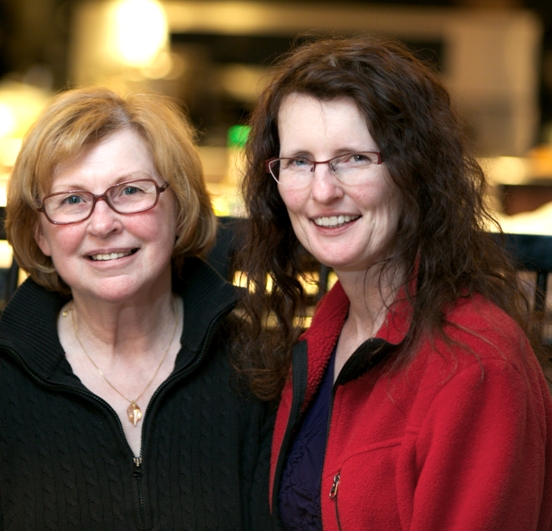
Margaret Jean, Irene Good and Beverly at the Ladner Rotary Luncheon.
Recently, I was asked to give a talk to the Ladner Rotary Club on Asperger’s. The date they had in mind was only four days away. Probably their scheduled speaker bailed, but I’m just happy to have a chance to increase awareness. It’s all good, right? Four days? I could do this.
I phoned my daughter, Bev right away.
“A room full of business people?” Bev asked. “Great. We’ll talk about Asperger’s in the workplace.” See why I called her? Bev always knows what to do.
“Okay, I’ll talk about the origins of Asperger’s just to be sure they know what it is, and you do the workplace part,” I said. She agreed.
Here’s a bit of my part of the speech.
Thanks for inviting us to speak today. Free lunch is always good. But imagine if someone, say a co-worker, asks a person to lunch, and right away that person becomes anxious? Clearly apprehensive. Wouldn’t that be amazing? But for some people with Asperger’s, it wouldn’t be unusual.
So what is Asperger’s, anyway? And why is it called that?
Asperger’s came to be known as such this way: In 1944, in Austria, a paediatrician detected some odd behaviour in four of his young patients. They did not socialize well with the other children. Their non-verbal communication skills were virtually non-existent. When they talked? Their language was stilted or formal. And they seemed to each have a favorite topic which was of intense interest to them, and therefore dominant in their conversations. And finally, they seemed to have little or no empathy with the other children.
These findings were published, but only in Germany. The doctor’s name was Dr. Hans Asperger.
It wasn’t until 1981 when a British physician and psychiatrist, a Dr. Lorna Wing, published several case studies of her own, that Asperger’s was introduced to the world. Dr. Wing’s case studies exhibited similar symptoms as the children the Austrian doctor had observed, and she referred to them as having “Asperger’s Syndrome”.
Her studies were widely read and published, and her 1996 study is considered by some to be the definitive work on Asperger’s.
In 1992 the World Health Organization added Asperger’s to its list of diseases and disorders. In 1994, The American Psychiatric Association added it to their manual of Mental Disorders.
But today, researchers such as Simon Baron-Cohen of Cambridge University and Dr. Jim Tanaka of UVic emphasize that Asperger’s is not so much a disorder, disability or disease; It is more a difference in how the brain processes information.
Stay tuned next week for Bev’s part of the talk!
Yours truly,
Margaret Jean.
Autism Spectrum Disorder: A Reading List For Parents and Adults Who Live On the Spectrum.
Like Sheldon, I like research. Thus, books and therapies have been the topic of my latest blogs. I have not tried any of the therapies myself but feel they are a resource worth looking into.
As for books, here is my personal rating of three recent reads.
1. Quirky Kids by Perri Klass MD and Eileen Costello MD.
Published in November 2003, this is the earliest of the books covered here, so some information may be outdated. It is divided into three sections as follows:
1. Noticing and dealing with difference in your child. 2. Adjusting the home and school environment. 3. Science of Autism, including meds and other drugs.
What sets this book apart for me, is the inclusion of parental anecdotes which illustrate concerns, anxieties and solutions .
My take? It’s a comforting book for parents of ASD children.
2. Understanding Autism for Dummies by Stephen Shore and Linda Rastelli.
Truly a professorial approach, this book could be called “Everything you wanted to know about autism but didn’t know who to ask”.
Because the author himself is a person with autism spectrum disorder, he writes about the syndrome in a very positive way. Quite refreshing.
Information wise? Autism for Dummies is a 10/10.
3. FAST MINDS: How to Thrive if you have ADHD or think you might. By Dr Craig Surman and Tim Bilkey. February 2013 first edition.
Latest in this list of books, I found this a most practical guide. Take the logic behind my weird schedule for instance. The authors explain how my habits more than my brain, keep me up late at night until the wee hours of the morning.
Thus I’m often exhausted which can lead to poor motivation to do anything. Doing nothing when I have lots to do makes me feel out of control. That can be depressing.
But the doctors also explain how forming new habits can change this pattern, and what new habits need to be developed. (they also explain the brain science behind developing new habits).
So I figured out I like to write between midnight and 5 a.m. because there are far fewer distractions at that time.
However, this is only productive if I am getting enough sleep at other times of the day.
And thanks to FAST MINDS, I now know to slot sleep with other scheduled tasks. In other words, I can be organized about being weird! How great is that?
I really like this book. It has opened a lot of mental windows for me, helping me to see where a lot of my issues stem from organically.
Therefore? In terms of being helpful? I’d give this book a 13 out of 10.
Yours so very truly,
Margaret Jean.
Asperger Traits? Really?
I love this video about Asperger’s traits: http://www.youtube.com/watch?v=d7lQa3q_OAk&feature=related . It seems to me to be thoughtfully put together. But I am tired of hearing that Aspie’s have no empathy, and imaginary worlds are beyond us.
In my book, Unforgiving, Memoir of An Asperger Teen, soon to be out on Amazon, I talk about the part imagination played in helping me through my childhood.
And why, if imagination is not our strong suit, are so many inventors, film makers, and landmark thinkers such as Isaac Newton, included (often posthumously) in the syndrome? These are obviously people with foresight and the ability to envision possibilities that are beyond others’ comprehension.
Difficulty with writing imaginatively? Thinking? I highly doubt it. It is precisely the ability to see beyond their current limitations that made these people famous!
So what? you may say. These people were not diagnosed, they are just presumed by some people to have Aspergers’ or Autistic tendencies.
Well then let me give you the example of my grandson, who was diagnosed at an early age as being in the autism spectrum, and who, before he had graduated highschool, had written an entire book length story based in a science fiction fantasy world that he created.
As for empathy–It isn’t that we don’t experience empathy–it’s that our voices, faces and body language don’t show it. We have what is called “flat affect”. This makes us seem to have no response to events. We also have little or no tonal expression (unless we’re in panic mode and often, even then!).
Thus, it’s very difficult for people to grasp when we’re feeling anything. Sometimes we might be totally panicking inside, or absolutely happy about a suggestion someone has made, but we don’t express this well.
I remember watching a woman exclaim expressively and happily about a suggestion her husband had made. Asperger me, I thought her very melodramatic. Seriously, I thought that sort of facial and tonal response belonged only on the stage!
Undoubtedly some people who do not feel empathy and/or have trouble with imaginative thinking are in the Autism Spectrum. Just as others who lack empathy and imagination, are not in the spectrum.
Yours truly,
Margaret Jean.
 Margaret Jean