Category Archives: Adult Aspies and Social situations

Autism and Life Beyond the Herd

This above all: to thine own self be true, And it must follow, as the night the day, Thou canst not then be false to any man*. 

You may often hear or read this quote: the epitome of self-awareness. As someone on the Autism Spectrum, it registers with me. It must be so for many people now and also throughout the ages since Shakespeare’s time, because it is often quoted.

And yet, it is commonly known that humans are born with the herd instinct.

For instance, in Chapter nine of Atomic Habits, James clear states that the human brain is programmed with the desire to be like everybody else. 

This need originates in a protective instinct which triggers the drive to be included–The aptly named ‘herd instinct’. To belong, to imitate the successful integrative and admired behaviours of others, to go along with behaviours we might secretly deplore, stems from our earliest prehistory.

As cave dwellers, and tribesmen, living within the group we were protected, we could benefit from shared resources.  On our own, alone, banished, or ostracized, we became easy targets for wild animals, other tribes, disease and injury. Vulnerable.  Miserable. Usually prey. Ultimately dead.

Safety was an overwhelming issue. As for procreation, the presence of at least one other person was required. Then there’s the bonus of shared resources as well as shared responsibilities. Going along with the prevailing group meant not only survival but a more desirable quality of life.

Theoretically our habits and behaviours are influenced by the culture in which we are born, raised and which we enter into as adults. 

Scientifically we are told that our brains are programmed to want to be aligned with the position assumed by the majority, and the powerful.

Research has proven time and again that being smart, being right, being true to yourself is less important than aligning oneself with the prevailing opinion.  This is ingrained in our being. Man is mentally programmed to respond in this manner.

I realized as I read this that, surprisingly, I had never wanted to be like everyone else.  In my memoir “Unforgiving” I explained that while my teenaged peers wanted to be different, they only really wanted to be different from their parents–not from each other. As for me:

I wanted to be the one and only Margaret Jean on the planet, and I wanted to be indelibly stamped as that single original sample of humanity whose Margaret Jean-ness would permeate every cell of her body and shine through everything she did.

That led me to think about other autistic people, in my family and in my friendships and acquaintances. Many of them have expressed the same feeling: Yes, we want to be accepted.  Yes, we want to be understood.  And no, we do not want to be like everybody else.

We value our uniqueness, the different way we perceive situations and people. Our evaluation of events and information. For instance, what if Temple Grandin had given in to everyone else’s concept of the behaviour of cattle, ignoring her insights as to their behaviours?  What if she had not had the courage to pursue the possibility of uniqueness in her brain?

We shouldn’t feel apologetic for being autistic.  It is how we were born, who we are.

I may misunderstand some social situations, but I may also have a deeper understanding of some.  I may be more intent on social justice than I am on fitting in. Is that really a bad thing? 

Our friends and family want to draw us into the herd for our own protection.  For our own social welfare.  For our own social ease. Admirably, they are thinking of our own good.

But is it what we want? Do we seek permission to be who we intrinsically are?  Do we need it? Those few who make it—how do they do it? By accepting themselves…By being true to who they are.

*Hamlet, act I, scene iii, lines 78–80.

Tagged , , , , , , , , ,

Navigating Relationships: Insights from Autism and Philosophy

Growing up on the autism spectrum, I never understood power in personal relationships.  I naively assumed that as adults, people would just naturally treat each other with respect and acceptance. 

People would want what was best for themselves and for the other person.

And in the workplace that would translate to balancing out the needs of the client, with the efficiency and profitability of the firm, while developing processes which would enable workers to do the best possible job with efficiency, pride and productivity.  For a fair wage.

Once I found myself in the ‘real’ world, I had no idea how to navigate the stresses and anxieties of very different personalities malfunctioning together in the work place.

I once complained to my sister that in the personal relationship I was then immersed in, I was the only powerless person.  I was sobbing.  Her response was straightforward:  You have the power, Marg.  You just don’t use it.

The truth? I didn’t know how.

I’ve learned to hold my own since then.  And recently I’ve found two books that clearly speak to this issue. It’s a relief to find authors who clarify the critical aspects of successfully managing stressful interpersonal relationships. 

Because we all find ourselves in situations that require working with or being with other people. 

Situations like Life.

Ichiro Kishimi and Fumitake Koga, two Japanese authors, explore the emotional fallout that can result from coming into contact with ‘the real world’. In their book, The Courage to be Disliked they discuss the calming effects of accepting and embracing who you are.

This book does not even mention autism spectrum disorder. 

Instead, the authors talk about our response to people and situations, and how we can find contentment regardless of what others may think about who we are and what we choose to do.

The format Koga and Kishimi chose for the book is loosely based on Plato’s dialogues.  That is, it’s a plain-language conversation between a philosopher and a young man, revealing the philosophical or Adlerian keys to being true to yourself.

I enjoyed the back and forth discussion; the young man constantly challenging the concepts and ideas put forth by the philosopher.

The discussions  explore the acknowledgement that others are not always going to be aligned with your personality and goals.  In short, they examine how a person can best move forward regardless of the opinions and/or criticisms of others.

Kishimi and Koga discuss our concern about what others might think—and note that this is different from caring about others—and how that emotional involvement with what others think about us, can hinder progress toward being our best self.

It’s a clear philosophical foundation for living your life freed from the inhibiting power of what other people think.

Along the same lines, but much more in the vein of a self-help revelation is The Let Them Theory by Mel Robbins. 

Robbins covers topics from achieving your goals to making, maintaining and letting go of friendships.  Her premise is simple: Do people shun you?  Let them. Do others criticize you?  Let them.  Do they do things you would never do?  Let them.  Let go of critical judgements, critical of yourself and of others.

The letting go is only the first step.  Robbins is clear that two steps are needed for this theory to work in an emotionally healthy way. The second step is, after acknowledging the issue that makes you think, “Let them”, you will then go on to explore self-validation in a way that is satisfying to you.

Her delivery, far from being philosophical, is very personal and direct. 

As spectrum riders, we can mourn our social/political/employment situation, or lack thereof, to our heart’s content. But at some point, we have to pick up our tents and move into the real world.  And hopefully?  Make a difference, however small.

Yours truly,

Margaret Jean.

Tagged , , , , , , ,

Understanding Empathy in Autism: A Personal Reflection

How often have you read or been told that people on the spectrum have no empathy?  In my case, I can’t think of anything further from the truth!

When we were little, my older brother and I were mischievous.  Our grandfather had a beautiful vegetable and rose garden.  Manicured green lawns edged the rows of peas, cucumbers, green beans, tomatoes and root vegetables.  One day, when I was about four years old, and my brother seven, we found ourselves alone in the garden. 

My brother looked carefully around.  Then he looked at me.  Then we both looked at the fat pea pods hanging on the vines.  Before long, we had eaten quite a few, stripping the fat peas from the pods.  I picked a small cucumber when we left.  I planned to eat it later with salt from the kitchen.

With the empty pea pods hanging on the vines, it wasn’t long before the adults discovered what we’d been up to.

My brother got blamed.  He was older than me, and he was supposed to be a role model for me, not a leader in crime.  He got a whopping.

From behind the closed doors, I could hear Dad spanking my brother.  My father was a big man and my brother was a small boy.  My dad was not a gentle person, especially not when he was in a temper. 

In the next room, hearing my brother’s yelps of pain, I cried.  I cried not because I was scared, but because I was sorry for my brother.  I didn’t want my adored big brother to be hurt or humiliated and I was witnessing both.  I felt how cruel and unfair it was, for such a big man to be hurting such a little boy. I sobbed as if my heart would break for him. 

So I know for a fact that I have a solid cache of empathy in my Asperger’s heart.

Perhaps ‘flat aspect’ plays a part in how I am perceived.  I may feel very sympathetic, but my face is void of expression and emotion.   

Do you, as I do, find it embarrassing and irritating when people get annoyed with you for not responding to something they have said?  They want a reaction, and they want it now–in a time frame and a manner that they anticipate. What they term ‘normal’.

When someone tells me a story, or confides in me about an incident, I have learned to remain expressionless, while I am processing what they have said.

I may be very empathetic with the opinion or situation.  But I know all too well that my ‘take’ on the situation is probably not acceptable.

This reminds me of what Heather is quoted as saying in Chapter 14 of Spectrum Women, that she finds she experiences things differently from other people.  Yes, we do have a unique way of processing input.

While I’m thinking deeply about what  someone has just said, I’m processing the information internally. But the person I’m conversing with is looking for an immediate, recognizable verbal or visual response.

My momentary hesitation does not mean that I have no empathy or sympathy for the person or situation. Nevertheless, that is how my apparent lack of immediate response is taken. 

On the other hand, if I do bravely venture my unedited opinion, the other person is likely to express surprise, dismay or even disbelief.  So, I find it’s better to just say something neutral and polite.

And because I have been told so often that whatever opinion, emotion or response I might express is inappropriate, I will sometimes not only not speak my mind, but also mask my facial response.

This would almost certainly lead people to think I am uninterested in the conversation.   

Why do people think we lack empathy? For myself, I think flat aspect and internalizing my perceptions may well account for this result. Inside, I may be roiling with emotion. Outwardly, I seem detached. Am I the only one?

Tagged , ,

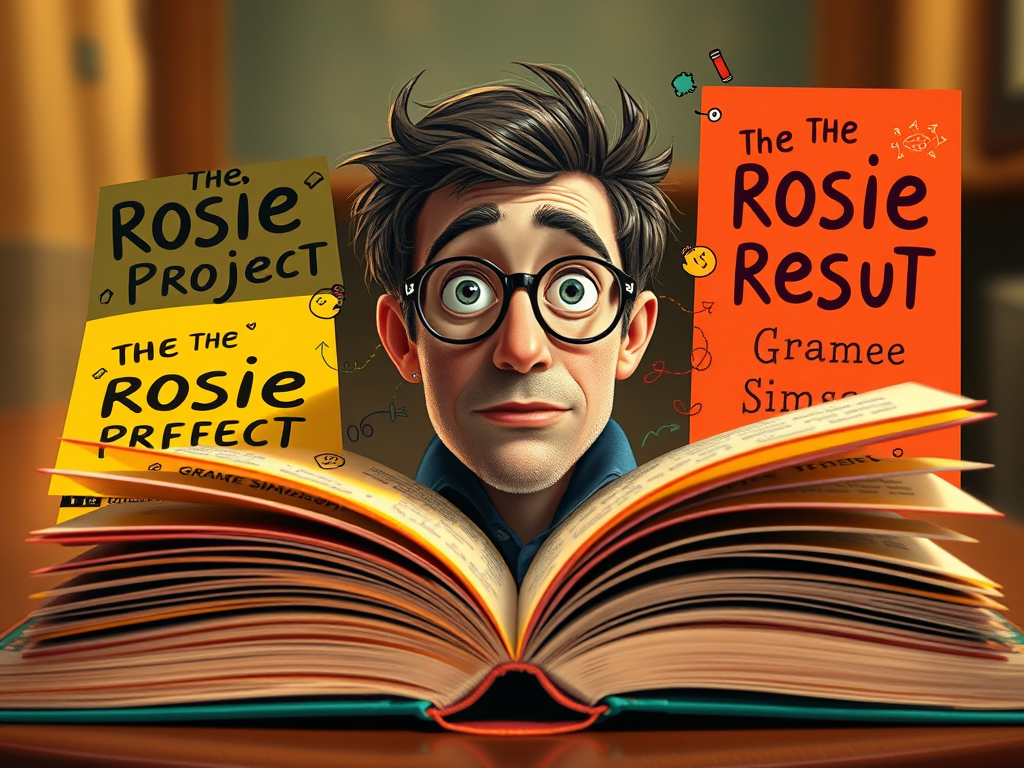
The Rosie Series: A Great Read for Spectrum Riders & Their Significant Others.

Has AI deliberately misspelled titles and author name?
Has AI misspelled titles and author name to avoid copyright issues?

The Rosie Books: The Rosie Project: 2013, The Rosie Effect: 2014, The Rosie Result: 2019

Graeme Simsion does not claim his series of funny, sensitive books featuring his character, Don Tillman, is about someone with Asperger’s or anyone who finds themselves on the spectrum.  But it is.  My partner read it, and he said that Graeme Simsion writes like I think.  I state my case.

One of the reviewers is quoted as saying “Sometimes you just need a smart love story that will make anyone, man or woman, laugh out loud.”  Reading that you might think that Simsion is making fun of us non-neurotypicals.  But he is honestly not. 

I laughed a lot when I read this book, and I know some of that came from the situations the author put our protagonist (Don) in, and Don’s response to them, but another aspect that made me laugh out loud was the joy of recognition. 

It’s comforting to know that Simsion could take our predicament and in the bright light of day, show the world with humour and tenderness what it’s like to be us.

Throughout these books, I recognized aspects of my grandsons, my daughter and myself. We share some characteristics, but each have put our own personal stamp on the spectrum label, as has every other Aspie.

My partner, who is not on the spectrum, on reading the Rosie Effect, had great admiration for Don (the main character).  “Here is this guy with severe social deficits, doing everything he can to correct them,” he told me when he finished reading the book.  “The guy knows he’s limited and he works in every conceivable way to change that.”

If only to acquaint ourselves with that attitude, and to enjoy a humorous look at what it is to be ‘us’ in social situations, this book truly is a must read.

Tagged , , , , , ,

Burning Bridges

While everyone finds it difficult to determine who can be trusted, it is especially so for those of us on the spectrum.

We are often unaware of intentions indicated by visual clues like body language, eye movement and facial expression. This inability can make us vulnerable, and too often the brunt of mean spirited, self-serving individuals.   

Others may purposely set us up, taking something they know we said in innocence, or jest, purposely repeating it to others out of context so as to make it sound harmful, cruel or vindictive. At best in the hope of personal gain, or worst, out of pure maliciousness.

In casual conversation with others we may make a sarcastic, but light hearted, innocuous, remark like, “Right! Because we all know Mary is so lazy!  Not!”  Soon the rumour circulating in the office is that you said Mary is lazy. You cannot deny that literally you did say that Mary was lazy, even though you meant to playfully convey the opposite.

Incidents like this are why those of us on the spectrum will often think carefully about what to say before speaking.  This pre-speech ‘pause’ can be misinterpreted by neural typicals as an indication that we are not interested in responding. The fact is we are thinking our way through to a socially appropriate response.  

Who to trust?  We cannot guard our every word. There will always be others who prey upon our ‘differences’ with selfish motives.  

Our best defence is to speak honestly, in a clear, straightforward manner, simply stating our intention.  In this way we can avoid the temptation to overly qualify or clarify what we have said, after the fact.  

It is important to always speak with goodwill.  But it is equally important to be careful about who you engage in conversation.  That person you joked with about Mary?  Future conversations with that individual must be limited to factual information, devoid of social playful banter.

Having difficulty making friends means we will often excuse people’s bad behaviour to keep the ‘friendship’ alive.  But this is setting ourselves up for constant betrayal.

Certain conversational topics are great gateways through which to get to know others. 

General topics, like the weather, TV shows, books, or current events can ease us into a new social relationship. Personally revealing conversation can be ammunition for self-serving bullies.

Save confidences for later, when you have had time to evaluate the trustworthiness of your new friends.

In her book, Aspergirls, Rudy Simone urges those on the spectrum to defend themselves “with tact and strength”.  She further counsels us to be constantly aware of the unpleasant personality traits possessed by certain people in our lives.

If you find yourself ostracized by others as a result of deliberate misinformation spread by an ignorant individual, there is little you can do to defend yourself.

In stressful situations such as these, Simone suggests that you take the ‘high road’, displaying as little overt anger, and as much grace as you can muster, in order to retain your personal integrity and self-respect.

“Remember the three R’s,” she counsels. “References, recommendation, and reputation.” You may need to maintain all three in order to have the life you desire. 

Tagged , , , , , , ,

Viewing Asperger’s through a Different Window.

John Elder Robison, who has Asperger’s, writes prolifically on Autism. He volunteered to undergo an experimental treatment which involved being subjected to magnetic stimulation of targeted areas of his brain.

There have been extensive studies on Asperger’s by neurophysiologists during the past 30 – 40 years. During the past 15 – 20 years, the emphasis has been upon the difference in utilization of the Cerebral cortex and the Amygdala aspect of the Cerebellum between neurotypicals and those on the Autism Spectrum.

These studies reveal how information with an emotional content, especially when personally conveyed, is largely processed in the Cerebral cortex by those with Asperger’s rather than in the Amygdala where it is processed by neurotypicals.

The result is those of us on the autism spectrum process information with emotional content logically, rather than emotionally.

However, the richer the contextual content associated with the information, the greater the ability of Aspies to ‘understand’, even if they cannot ‘directly experience’ the emotion being expressed.

In the experimental treatment in which Robison participated, he didn’t immediately notice any difference.

But the next day, when he interacted with others, he was unexpectedly overwhelmed by an almost ‘psychic’ awareness of their emotions. 

He was assailed by emotions of “jealousy, fear, anger and every bad thing I could imagine” (Neale). It was an unexpected torrent of emotions which he experienced as shocking and distressing.

This situation, one of being admitted to an emotional landscape which is usually unavailable, puts me in mind of Virginia Woolf’s comment in A Room of One’s Own about patriarchal rules in Oxbridge. At the library, she was refused entrance because of being a woman.

In social situations, as a person with autism syndrome, I feel as Woolf did “…how unpleasant it is to be locked out;” (18).  

But when I am composing a poem like Exonerating Eve which expresses such a divergent but powerful viewpoint, then, like Woolf, I cannot help but ponder the alternative, as she did when she added, “… and I thought how it is worse perhaps to be locked in;” (18).

Aspies, such as myself, come to realize early in our lives that we are somehow ‘locked out’. We learn to accept this and to make social inroads where we may.

But Robison’s experience indicates that our lack of social/emotional understanding is a ‘locking out’ that is at least in some respects beneficial, allowing us to experience the world in a way that, while ingenuous, is also unique and  insightful.

And thus I present my poem:

EXONERATING EVE

I know why Eve ate the apple

Picked and tasted forbidden fruit.

Locked in her Eden she hungered for more,

wanted proof that her life would not always be
just wandering the garden, a
 helpmate to Adam,

a servant to God.

In her heart she yearned for more than the beauty,

More than the silence. More than obedience.

Something within called her to challenge

the ‘perfection’ of a life established by God. 

Accepted by Man. 

Did The Creator witness her anguish? Did He
inspire her desire for more?

Gifting free will to all of humanity,

did He await our wakening thrill?

Did He seek a braver companion than one who
obeyed without question or zeal?

Was He astounded when it was the woman,

The feminine one who plucked and then peeled 

The Fruit that triggered a flood of passion
and reason, 
Wherein she
shrugged off obedience
and now saw
her truth?

 Newly aware, she sees in her nudity 

All that is vulnerable and desirable to men. 

Looking out at the garden she sees the reality, 

thorns and thistles suddenly visible.

And within her, awareness of a strong inner spirit,

God-given,
to prepare her for the journey 
that she now begins.

Eve ate the fruit to be free from the fallacy

That her life was perfect. 

She dared to be more than that helpmate.

More than that servant.

To live in a garden that was an Eden no more.

A garden that now she perceives as a jungle.

A garden that asks her spirit to grow. 

A garden with pathways to be forged

and then trodden.

A life posing questions, needing answers,

Revealing wonders, unveiling horrors. A life to be
probed. A will to be tested.

Searching for truth, for reason and passion,

She reaches up, plucks The Fruit from the tree.

And in that critical, wonderful moment,

Plunges mankind into uncertainty, Drawing us
all out of complacency.

 Here in the midst of this pandemic, I understand
a woman like Eve.

As I sit and reflect on the life I’ve created,

I challenge myself to find more of me.

To ask the hard questions, to reach for the truth. 

To find in myself the courage to ask 

the questions that, unanswered leave me unproved.

To reach for the core, the richness of life. Face my own
fears, grapple with and tame them.

While I have time. While I am here, locked in this life Some would
call Paradise.

Yes. I have come to know why Eve ate that apple.

4:53 AM


Tagged ,

An Adult Aspie Looks at Friendship

Having trouble making friends? For people on the spectrum, this is a common situation. A recent study indicated that of the participants, more than half the children with ASD did not have a single close friend. How does a person learn to live with that?

I have been fortunate to have one or two friends who have remained constant. But mostly? Friends come and go.

My approach to friendship is different from that of people who seem to know all the rules of bonding and building peer relationships.

Occasionally, people come to have some meaningful connection with me, and then, for the most part, sooner or later drift away. And that’s okay because they always leave me emotionally richer, with lessons learned and experiences shared that I would not have otherwise had.

I have let go of my expectations of a life-long friendship when my life intersects with others. If we have no interests in common, or not enough to sustain a typical friendship, that’s ok.

Not forming a lifetime bond with others is not a failure.

I see my role as bringing light into their path just by virtue of being me.  I want to offer them a gift, introducing an upbeat, pleasant moment into their day. I may do this in many ways: with kindness, validation, humour or encouragement.

I see our meeting as a connection, not a life-long commitment.

I believe connecting with someone new occurs at a meaningful time for both of us, and that we are each somehow important in that moment for the other, assisting each other along whatever path we are individually, or jointly, travelling.

It is not for me to judge others, to work to improve the people who come into my life, or to see if we can converse comfortably for hours … although it is always a pleasant surprise when a lengthy, satisfying conversation occurs! 

Actually, shorter connections feel safer for me, I can avoid having to analyse whether what we have discussed or disclosed is really appropriate.

Just a connection that however fleeting, will be rewarding in the moment, and remembered with pleasure.

That’s not so hard to live with!

Tagged , ,

Reflecting Upon Our Social Interactions

Omigosh, was I really that unaware?

Recently we had lunch with some new friends. The hanging baskets cascaded their vivid blooms, the food and wine were perfect and the conversation flowed.

But the next day, reviewing one aspect of the conversation, I realized I had been guilty of that intense self-immersion we Aspies often experience.

At one point the conversation centred on an author I had recently met and whom my guest had recently heard interviewed on CBC Radio.  I waxed eloquent on my favourable estimation of this writer.  I elaborated on how we had come to know him and how respectful and talented we found him to be.

But not once did I ask our guest what impression he may have formed from hearing the author interviewed!!

Not only did I fail to learn more about our guest from his impressions, but I also lost the opportunity to later pass on feedback regarding the interview to our gifted friend.

And again it struck me that we all need to be aware of how we come across in social interactions with others.

Clearly social encounters present a learning platform for us.

Reviewing our most recent social encounters, reflecting upon how they went, upon both the positive and the negative, is a powerful exercise.

But it must be done without judgement, of ourselves or of others.

For me, a positive reflection of my interaction with others is simply an objective review of a conversation.  Where might I have been more thoughtful or encouraging of the other person?  Where might I have asked for clarification?

The key is to be kind to myself as I reflect.  To counsel myself as I would someone younger who has come to me for help.

When you reflect, love that you are learning, baby step by baby step, even as you make mistakes, perhaps even real blunders.  And then look for a way to move forward.

For instance, we have made plans to see these folks again, and when we do, you can be sure I will make a point of asking our friend about his impression of the interview.  He may not recall as much now, but I think he will be pleased that I remember our previous conversation and am interested in his point of view.

Everyone likes to have their thoughts, and especially their opinions acknowledged, and it is both polite and compassionate to be courteous to others when they address us.

My partner once received a card from a colleague who wrote, “You are the only person I have ever known who, when you ask me how I am, wait patiently for an answer.”

Whether it’s someone’s passing greeting in the hallway, or opening remark in the office lunchroom, or conversation over a meal, it is respectful to listen and to consider their words, rather than just thinking of what we want to say next.

Maybe sometimes we really just don’t care!

Here’s the thing: the first step in having others care about us, is caring about the collective others out there.

We must never stop attempting to make real, honest conversational forays. Yes, we are entitled to be selective in our conversational partners, but not exclusive.

Honest and frequent self-evaluation can help us to breeze through social encounters.

Try it!  A whole new world of social ease will present itself.

Margaret Jean

Tagged , ,

Aspies & Social Relationships: Where Our Problem Lies in Interpreting Facial Expression: The Prefrontal Cortex.

As Aspies, we know we have difficulty reading facial expression in conversation.  But why?

This is a question that Arlin Cunic addresses in her article Are Asperger’s Disorder and Social Anxiety Disorder the Same*.

I was fascinated to learn that when we are in conversation with others, how anyone reads facial expressions is determined by the routing that occurs in our brains.

In the case of a person with Asperger’s, the brain sends the image for processing to the Prefrontal Cortex.  This is the area of the brain that deals with judgments and planning.

In the Prefrontal Cortex, logic rules.

However, conversations between two people in a relationship are often fraught with underlying emotion, an aspect of the exchange that is unrecognized in the Prefrontal Cortex.

So, how do neuro-typicals process facial expression?

In most people, the translation of facial expression occurs in a different area of the brain. The amygdala, Cunic states, is where emotion rules and this is the part of the brain to which conversational signals are transmitted and processed in non-Aspies .

And other people, when reading facial expressions, will have an automatic emotional response.

This does not happen in Aspie brains, where the emotional message is subjected instead to logical analysis.

This logic-based interpretation of emotional content is one reason why, then, some of us are hugely challenged in the area of building and maintaining relationships.

Take an instance where someone we love has a life-long dream of being an actress or an architect.  Or when a partner says they need more touching, a more physical expression of our love.

When they convey to us that they want to pursue that dream or they need us to be more emotionally connected to them, we are most likely to process this information objectively.

We may list the pros and cons, the factors in favour, and the factors that weigh against this possibility.

But we may not have the emotional comprehension, the emotional connection necessary to understand how important this issue is to our loved one.

We may even create ‘logical’ defenses or arguments, objective discussions clearly designed to show why it is not a good idea at this time to fulfil the other’s wishes.

This can be hurtful to our partners, as it illustrates a complete lack of understanding of and empathy with our partner’s emotional needs.

Most likely we will nevertheless continue to process the information logically, because the prefrontal cortex is uniquely wired to deal only with rational and logical considerations.

As a result, we may be unable to comprehend why anyone would even want to do something that to us seems frivolous and unnecessary.

We may angrily protest that our partner has heard nothing we have said.

In fact, the opposite is true.  We have not heard what they have said.

We may well be incapable of doing so, unless we stop and listen.  Unless we can accept that there is something in the message that we are not getting.  Unless we allow them to lead us to that understanding.

Perhaps the person who wants to try a different career already has a good paying job that they would put at risk.

Maybe life together is quite pleasantly predictably organized and pursuing the new occupation would be disruptive both to the current routine and your joint finances.

Logically, their dream makes no sense to us, and therefore we may deem it invalid.

We may not be able to recognize the emotion and passion that accompanies these and other conversations.  We may even deem the expression of their needs as inconsequential, a foolish request.

The relationship will probably end here, because we simply cannot ‘get’ the other person’s point of view.  We are attempting to successfully process with logic, a request or desire that requires an emotional interpretation, and emotional support.

Knowing that we may well fall short in emotional support of our partners can give us pause.  We can stop and reconsider what they are saying to us.

We may never fully understand or empathize with the emotion that accompanies their need, but I believe we can learn to recognize when these conversations are happening.

We can learn to express appropriate responses, and commit to behaviours that acknowledge another’s emotional needs.

Is it worth it?  Giving in, when logic argues against it?  Think about the relationship and what it means to you, how being together enriches your life.  Think it through, and then decide.

Yours truly,

Margaret Jean.

*To read Cunic’s article go to :  https://www.verywellmind.com/how-is-aspergers-related-to-social-anxiety-disorder-3024753


Tagged , , , ,

The French Kiss: An Aspie Makes Peace with Her Past.

If you’ve read my memoir,  Unforgiving, Memoir of an Asperger Teen, you’ll know I was once subjected to a French kiss that was the beginning of a severely anxiety-producing period in my life.  This column is about a much better relationship: one with the French language.

As Aspies, we need constant challenge.  To live without it is a form of unpleasant inertia for us.

Perhaps that’s why we find games so absorbing; they challenge us while providing an anxiety-free way of being engaged.

An Aspie self-reflection might be to ask ourselves how we can utilize our Aspie focus in a more productive way.

This early in the morning, I’m usually doing a French lesson on Duo Lingo.  So far it’s free, I’m interested and I’m learning French!  As with many games, my online French lessons do not require any anxiety-causing social interaction, just self-motivation and tremendous concentration, at which Aspies excel.

Why French?  Because I have a brief background in the language, including some high school instruction (This is Canada after all, where French is our official second language) and some French at university where a second language was required in the first couple of years.

So, imagine my amazement when visiting in France I discovered that while I could read the signs, and understand quite a bit of what was said, I was unable to communicate verbally.  When it came to speaking my tongue got thick, my mouth got dry and I got stuck. That was an unpleasant and for me, rather traumatic surprise!

Now I spend a great deal of time in a household which includes someone who is a native French speaker; someone kind enough to teach me conversational French.

Taking  advantage of this opportunity with any degree of accomplishment meant revisiting the vocabulary, the conjugations and the grammar. Voila, Duo Lingo!

At first the conversational aspect was terrifying.  After all, it combined a modicum of social interaction along with the practise of something in which I had already failed while in France.  It was an effort to go into the sessions and blunder my way through.

Then, one day, for the very first time we had a conversation in which I could fully engage, understanding every word and being understood in return!  It remains so significant to me that I even remember exactly where we were standing in the kitchen when the exchange took place.

I may never get back to Hyeres in the south of France, but I will have the satisfaction of being able to speak in another language.  To wrap my brain, my tongue, and my throat around another verbal method of communication can only be good for me in so many ways.  Surprisingly, each night, my dreams include a word or phrase in French.  And the exercises, now that I am in my third month of self-imposed study, have become far more complex; a challenge I enjoy.

Is French helping me in any measurable way?   I cannot say.  I can only say that the universe has opened up this opportunity for me.  And I learned a long time ago—do not say ‘no’ to the universe!


Tagged